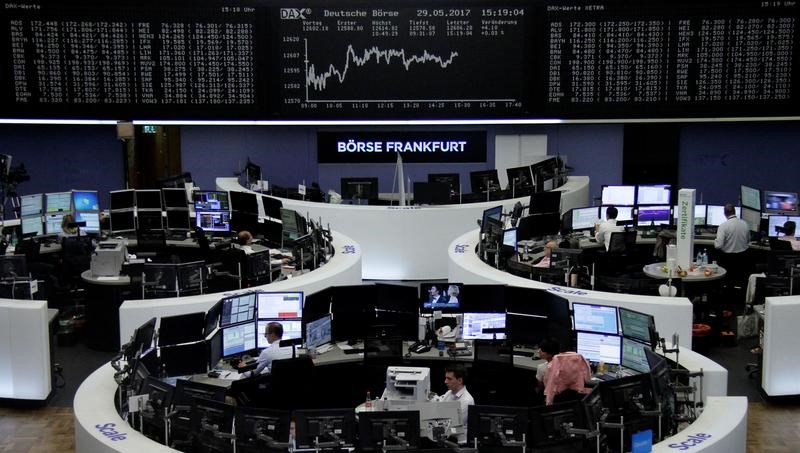
 © Reuters. Traders work in front of the German share price index, DAX board, at the stock exchange in Frankfurt
SINGAPORE (Reuters) - Concerns
about situations involving Greece, Italy and the European Central Bank
kept the euro under pressure on Tuesday.
European geopolitical
fears sapped risk appetite, weighing on Asian stocks and lifting safe
havens including the yen and gold, though trading was thin with several
markets closed for holidays.
For Tuesday, European stock markets were set for a soft start, with financial spreadbetter IG Markets expecting Britain's FTSE and France's CAC 40 to open 0.15 percent and 0.3 percent lower, respectively, and Germany's DAX (GDAXI) to start the day flat.
The euro slid 0.45 percent to $1.1114 in its fourth session of declines.
James
Woods, global investment analyst at Rivkin Securities in Sydney,
attributed most of the currency's decline on Tuesday to a German press
report saying Athens may opt out of its next bailout payment if
creditors cannot strike a debt relief deal.
"The bailout
payments are necessary to meet existing debt repayments due in July, so
if Greece were to forgo this bailout payment the probability of a
default would spike, reopening the discussion around a Grexit from the
Euro zone," Woods said.
However, he cautioned against reading
"too much into it" without more details or confirmation, adding it was
unlikely Greece would forgo the bailout payment at this stage.
Euro
zone finance ministers failed to agree with the International Monetary
Fund on Greek debt relief or to release new loans to Athens last week,
but did come close enough to aim to do both at their June meeting.
Comments
by former Italian Prime Minister Matteo Renzi on Sunday in favor of
holding an election at the same time as Germany's in September also
raised uncertainty and pulled the euro lower.
So did a statement
by European Central Bank President Mario Draghi reiterating the need for
"substantial" stimulus given subdued inflation.
MSCI's broadest index of Asia-Pacific shares outside Japan (MIAPJ0000PUS) fell 0.2 percent with U.S. and British markets closed on Monday.
China, Hong Kong and Taiwan markets are closed for holidays on Tuesday.
Japan's Nikkei (N225) ended flat, held back by a stronger yen.
South Korea's KOSPI (KS11) fell 0.4 percent as investors took profits following the market's record-breaking rally this month.
North
Korean leader Kim Jong Un supervised Monday's test of a new ballistic
missile controlled by a precision guidance system and ordered the
development of more powerful strategic weapons, the North's official
KCNA news agency reported on Tuesday.
South Korea said it had
conducted a joint drill with a U.S. supersonic B-1B Lancer bomber on
Monday. North Korea's state media earlier accused the U.S. of staging a
drill to practice dropping nuclear bombs on the Korean peninsula.
European blue-chip stocks (STOXXE)
fell 0.2 percent on Monday, with Italy's banking index sliding 3.4
percent, its biggest loss in nearly four months, after two lenders
sought help to cover a capital shortfall.
Sterling
retreated 0.2 percent to $1.2809 after British Prime Minister Theresa
May's lead over the opposition Labour Party dropped to 6 percentage
points in the latest poll to show a tightening race since the Manchester
bombing and a U-turn over social care plans.
The dollar declined 0.4 percent to 110.88 yen .
The dollar index (DXY), which tracks the greenback against a basket of trade-weighted peers, however, advanced 0.3 percent to 97.751.
Markets
are awaiting economic indicators including French first quarter gross
domestic product, German inflation data for May, and U.S. inflation for
April later in the session.
In commodities, oil prices
retreated, as concerns lingered about whether the extension of output
cuts by OPEC and other producing countries will be enough to support
prices.
U.S. crude futures (CLc1) slipped about 0.1 percent to $49.78 a barrel.
Global benchmark Brent (LCOc1) fell 0.4 percent to $52.09.
Gold rose 0.1 percent to $1,268 an ounce.


No comments:
Post a Comment